dummify™

dummify™dummify™dummify™
  • Home
  • Where Things Click
  • Parents Start Here
  • 3 Learning Situations
  • Resources
  • Orientation Guides
  • Brain Candy
  • Sour Candy
  • Research Sources
  • About
  • Thinker Type Quiz
  • More
    • Home
    • Where Things Click
    • Parents Start Here
    • 3 Learning Situations
    • Resources
    • Orientation Guides
    • Brain Candy
    • Sour Candy
    • Research Sources
    • About
    • Thinker Type Quiz

dummify™

dummify™dummify™dummify™
  • Home
  • Where Things Click
  • Parents Start Here
  • 3 Learning Situations
  • Resources
  • Orientation Guides
  • Brain Candy
  • Sour Candy
  • Research Sources
  • About
  • Thinker Type Quiz

Tools and explanations to help learning make more sense.

Not all minds think the same way.

When learning matches how a mind works, understanding becomes possible.
 

Download PDF

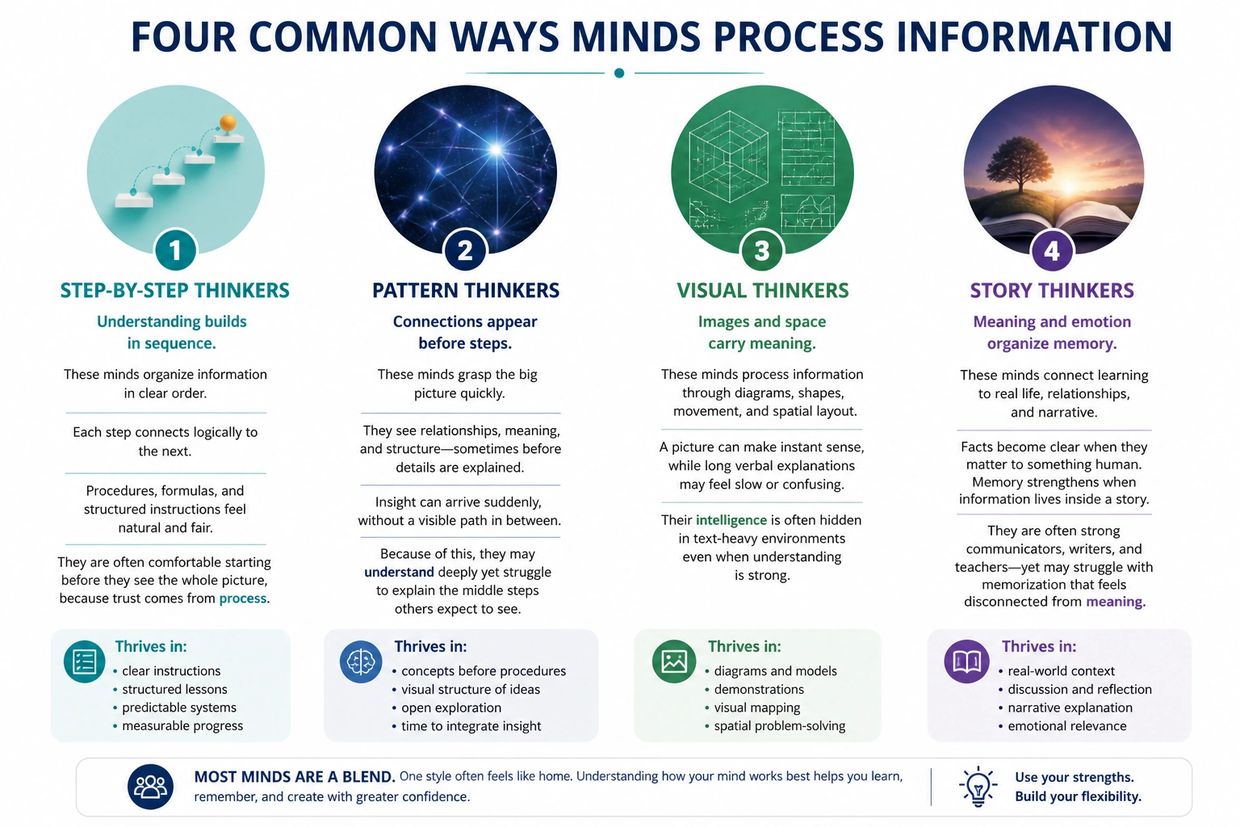
Four Common Ways Minds Process Information

Step-by-Step Thinkers

Step-by-Step Thinkers

Step-by-Step Thinkers

Understanding builds in sequence.


These minds organize information in clear order.


Each step connects logically to the next.


Procedures, formulas, and structured instructions feel natural and fair.


They are often comfortable starting before they see the whole picture,
because trust comes from process.


Thrives in:


  • clear instructions
     
  • structured lessons
     
  • predictable systems
     
  • measurable progress

Pattern Thinkers

Step-by-Step Thinkers

Step-by-Step Thinkers

Connections appear before steps.


These minds grasp the big picture quickly.


They see relationships, meaning, and structure—sometimes before details are explained.


Insight can arrive suddenly, without a visible path in between.


Because of this, they may understand deeply
yet struggle to explain the middle steps others expect to see.


Thrives i

Connections appear before steps.


These minds grasp the big picture quickly.


They see relationships, meaning, and structure—sometimes before details are explained.


Insight can arrive suddenly, without a visible path in between.


Because of this, they may understand deeply
yet struggle to explain the middle steps others expect to see.


Thrives in:


  • concepts before procedures
     
  • visual structure of ideas
     
  • open exploration
     
  • time to integrate insight

Visual Thinkers

Step-by-Step Thinkers

Visual Thinkers

Images and space carry meaning.


These minds process information through diagrams, shapes, movement, and spatial layout.


A picture can make instant sense,
while long verbal explanations may feel slow or confusing.


Their intelligence is often hidden in text-heavy environments
even when understanding is strong.


Thrives in:


  • diagrams and models
     
  • d

Images and space carry meaning.


These minds process information through diagrams, shapes, movement, and spatial layout.


A picture can make instant sense,
while long verbal explanations may feel slow or confusing.


Their intelligence is often hidden in text-heavy environments
even when understanding is strong.


Thrives in:


  • diagrams and models
     
  • demonstrations
     
  • visual mapping
     
  • spatial problem-solving

Story Thinkers

Step-by-Step Thinkers

Visual Thinkers

Meaning and emotion organize memory.


These minds connect learning to real life, relationships, and narrative.


Facts become clear when they matter to something human.
Memory strengthens when information lives inside a story.


They are often strong communicators, writers, and teachers—
yet may struggle with memorization that feels disconnected

Meaning and emotion organize memory.


These minds connect learning to real life, relationships, and narrative.


Facts become clear when they matter to something human.
Memory strengthens when information lives inside a story.


They are often strong communicators, writers, and teachers—
yet may struggle with memorization that feels disconnected from meaning.


Thrives in:


  • real-world context
     
  • discussion and reflection
     
  • narrative explanation
     
  • emotional relevance

Most people are not just one type. They are a blend.

But one way of understanding usually feels like home.


When learning meets that place, clarity stops feeling impossible—
and starts feeling natural.

Subject orientation

Guides you can enter in any order.

How Understanding Works

How Understanding Works

How Understanding Works

What needs to be clear before information can make sense. 

Read the explanation

When Learning Stalls

How Understanding Works

How Understanding Works

What’s usually missing when understanding doesn’t land. 

Read the explanation 

Different Starting Points for Understanding

Different Starting Points for Understanding

Different Starting Points for Understanding

Why some explanations work only after the whole is visible. 

Read the explanation

A Short Orientation Guide (PDF)

Different Starting Points for Understanding

Different Starting Points for Understanding

A portable explanation you can read when learning doesn’t land. 

Download the guide (free)


Subject Orientations

Orientation for Learning Math

Orientation for Learning Science

Orientation for Learning Science

What needs to be clear before math instruction can make sense — so learning math doesn’t feel harder than it has to.


Explore the orientation →


Orientation for Learning Science

Orientation for Learning Science

Orientation for Learning Science

What needs to be clear before scientific concepts can make sense — so science doesn’t feel confusing or fragmented.


Explore the orientation →

Orientation for Learning Writing

Orientation for Learning Science

Orientation for Learning Writing

What needs to be clear before writing can flow — so writing doesn’t feel blocked or forced.


Explore the orientation →

Orientation for Learning History

Orientation for Learning Science

Orientation for Learning Writing

What needs to be clear before historical information can make sense — so history becomes coherent, not crowded.


Explore the orientation →

dummify™ in action

Copyright © 2026 dummify.ca - All Rights Reserved.

Powered by

This website uses cookies.

We use cookies to analyze website traffic and optimize your website experience. By accepting our use of cookies, your data will be aggregated with all other user data.

DeclineAccept