


Not everyone learns the same way

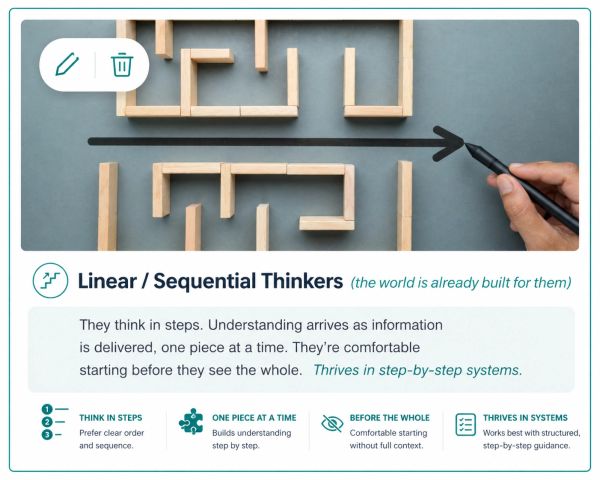
Reflective / After-the-Moment Thinkers
Understanding arrives later.
Not because they weren’t paying attention — but because their mind integrates offline.
Insight forms after space, not on command.
Thrives with time and quiet processing.

Inside a Student’s Thinking
A composite illustration
This example is written to make a student’s internal experience visible.
It does not describe a single individual.
Before orientation
Sometimes I understand this subject.
But most of the time, I don’t.
Even when we’re doing something familiar—
only now we’re moving forward and learning more—
I don’t know where we are anymore.
In class, I follow along while the teacher explains.
The words make sense. I copy things down.
But sometimes it’s too fast.
I try to make sense of one idea while the lesson has already moved on,
and I end up missing that part too.
Later, when I’m alone, everything disappears.
I remember pieces, but I don’t know what they mean.
My mind goes blank.
I assume I forgot something obvious—
some rule everyone else understands.
So I reread notes, watch videos, and try again.
Sometimes it works. Often it doesn’t.
When I get stuck, I don’t know why I’m stuck
or what kind of help to ask for.
Eventually, I stop asking questions
because I don’t even know what to say.
During orientation
This wasn’t really a lesson.
It didn’t start with the "do this task".
It started with what the meaning of the subject is,
what it’s asking me to do,
what kind of thinking it uses,
and where mistakes usually happen.
For the first time, the confusion didn’t feel personal.
I could see why I was confused.
I realized I hadn’t been missing steps—
I just didn’t understand the meaning of them yet.
Once that was clear, things began to connect.
I could see patterns.
I could see why mistakes repeated.
I could tell the difference between
not understanding an idea
and misusing it.
Nothing felt easier.
But it felt clearer.
After orientation
Now when I get stuck, I don’t panic.
I step back and ask different questions:
- What is this question really asking?
- Where do I begin?
- What kind of thinking does this require?
I still need help.
I still make mistakes.
But I’m not lost anymore.
Instead of thinking,
“I’m not good at this,”
I think,
“I can see what kind of thinking this needs—
I just haven’t practiced it enough yet.”
That makes a difference.